
Show Up, Shout It Out & 100 Rejections
#2018Goals: Show Up. Photo by Megy Karydes.

#2018GOALS: Show Up. Photo by Megy Karydes.
What do you want to get done before the end of 2017 and in 2018?
We’re in the final quarter of 2017 and I’ve already plotted out my work plan for the rest of the year, based on current assignments and client deliverables. Around this time I also start reflecting on what I set out to do this year as well as what I want 2018 to look like.
Show Up
One thing I really wanted to do more of this year was show up, meaning get out there and connect with people in real life. If I couldn’t meet them in real life, I could at least try to make a connection via social media.
Result? No great, but not bad.
My goal is to continue to show up in 2018. You never know who you’ll meet, after all.
Shout It Out & 100 Rejections
Another good reminder from a friend of mine: when you want something, ask for it. Kids have this down to a science. When they want something, they make sure everyone knows.
You know what? It works.
What do you want to happen in 2018? Let your friends, family, colleagues know! You never know who knows someone who can help you.
Here are my goals for 2018:
· secure an agent and publisher for my memoir
· secure a ghostwriting contract
· seek out more speaking opportunities
· secure 100 rejections ~ because if I don’t put myself out there, I can’t get rejected; but if my goal is to get to 100 rejections, that means I’m sending stuff out there, which means some might come to fruition!
Humble Brag
Speaking of goals, one of those goals was to score a piece in Politico. Several of my friends knew this and knew of my work around health care issues so they recommended me as the writer. The story finally published two weeks ago. It’s about America’s health care heroes: family caregivers. Thank you, Kate Silver and David Himmel, for making that connection. You can read their pieces here and here. It’s worth a read.
7 Ways To Becoming A Successful Freelance Writer

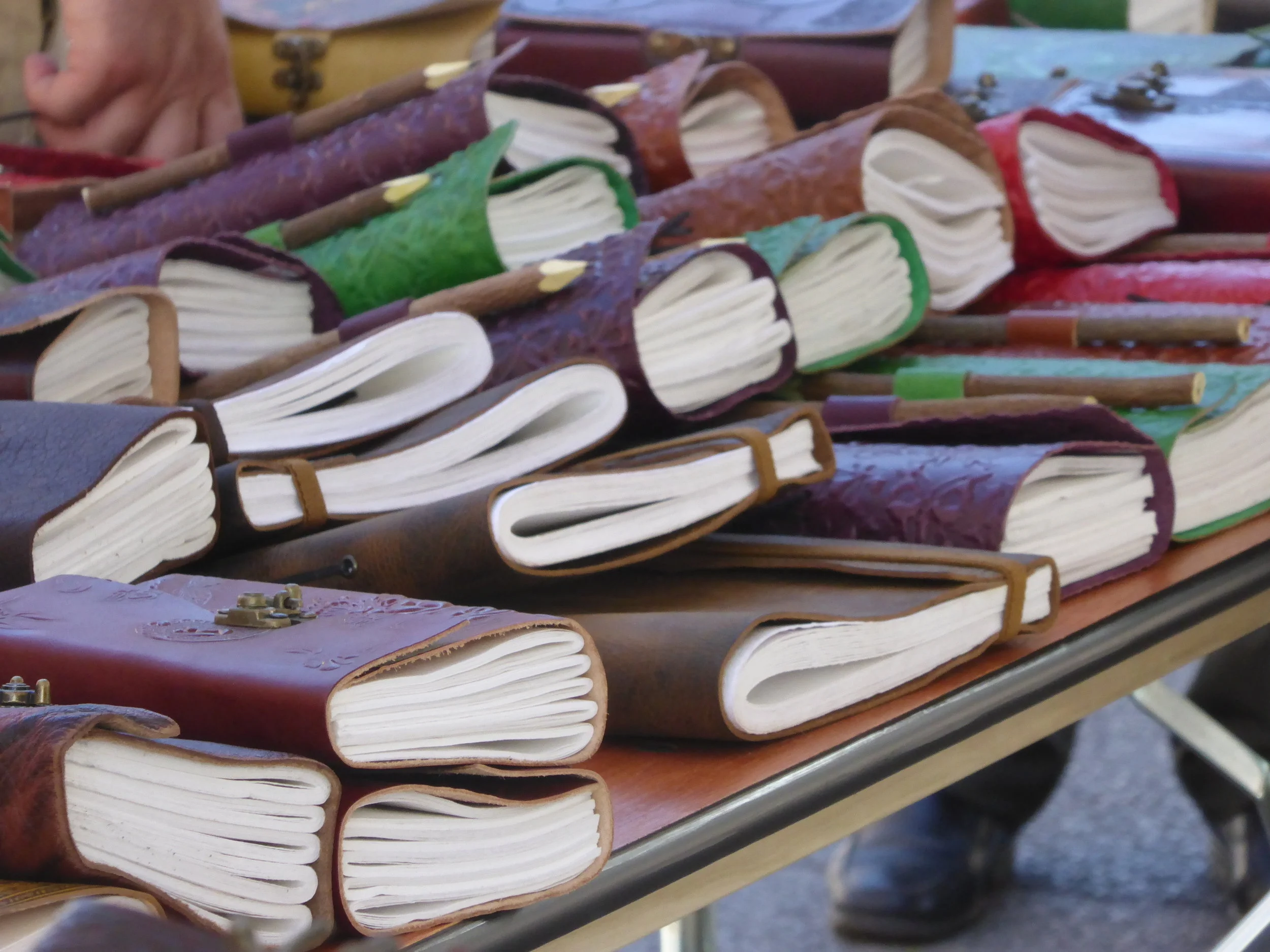
Leather-bound journals waiting to be filled. Printers Row Lit Fest in Chicago, 2017. Photo by Megy Karydes.
Every now and then a friend will ask how they can break into freelance writing and quit their job. Or the person is a writer and wants to step up their game and make a living from their craft. I’ve been invited to present and be part of panels on how to success as a freelance writer, some with titles such as “How To Become a Six-Figure Freelance Writer” or “How To Quit Your Job and Freelance Write”. Tonight, I’m on a panel with other freelance writers talking about successful freelance strategies to Columbia College Chicago students and alumni.
As I was preparing my material for the panel discussion, I wanted to share seven things I did (and continue to do) that have helped me get better at this freelance writing game over the past decade.
1) Join & Be Active. It’s not enough to pay your dues. If you’re going to be part of an organization or association, be active. That’s how you’ll meet others and learn from them. If you can’t attend the conferences, be active on the forums. This is often where you can meet with editors, content managers, etc. In many of these conferences, you’ll have time to pitch them directly, too. There are associations for almost any niche you’re interested in, from health to science writers, writers who write for online news outlets to travel-focused writers.
- American Society of Journalists and Authors
- ASJA Chicago event in November (including info on freelancing and ghostwriting)
- Association for Women Journalists – Chicago
- Association of Writers and Writing Programs
- UPOD Academy
- Freelance Success
Start your own Writers Accountability Group and commit to meeting regularly or connecting regularly online
2) Continue to Learn & Improve Your Craft.
a. Read books.
- Bird by Bird by Anne Lamott
- Six-Figure Freelancing by Kelly James
- Goodbye Byline, Hello Big Bucks: The Writer’s Guide to Making Money Ghostwriting and Coauthoring Books by Kelly James
- On Writing by Stephen King
- The Art of the Book Proposal by Eric Maisel (if you’re working on a book)
b. Listen to podcasts
c. Take classes.
- StoryStudio Chicago
- Writer’s Studio at University of Chicago Graham School
- The Fifth Semester (if you’re working on a book)
3) Get Out There.
- Let everyone you know you’re a writer. Not an “aspiring” writer. You’re a writer. Own it. Assume your place at the table. You’ll never know who might need content for their blog, help writing their bio page on their website, or a profile piece for a local print magazine.
- Also, talking with others helps you discover stories to pitch. Your neighbor might have a scoop, your dry cleaner might have heard something, your local public school might be doing some neat things and the teacher might be happy to share details. Letting people know what you’re doing will help you in the short and long-run because people will keep you posted of news they hear!
4) Become Friends with Writers.
- One of the biggest myths in this business is that you need to pitch editors in order to get stories assigned. While technically that’s true, editors (or clients) are the ones who assign the business, it’s often through your network of friends/colleagues that you FIND the business to be had.
- Friends writing for editors and clients sometimes get asked if they have any other friends interested in picking up new work. If they know you’re looking and feel you have the skill sets, they’ll recommend you. Ninety percent of my work has been secured through networking and/or referrals. And the ten percent I cold pitched, I ended up referring others to those editors so they got work out of my cold pitch, too.
- Sometimes my editors are looking for writers with a specific type of expertise or I can’t write about something because it poses a conflict of interest to me. For example, an editor asked me to write about clean energy for a print magazine but one of my clients is active in this space. I ended up referring a friend who I knew was well-versed in the subject and she wrote about the topic. Happy editor because I referred someone to her + happy friend because she’s now working with a new editor = win for everyone.
5) Know Your Worth & Treat It Like a Business.
- Track your time (see 6e for recommendations)
- Set up a spreadsheet or some other system to track your clients/editors/work by client and month. Track your expenses like a hawk. Track your revenue by month.
- Set aside money for taxes.
- Set aside money for retirement.
- Set weekly/monthly/quarterly/annual goals and review them weekly/monthly/quarterly/annually.
- Negotiate rates. Ask if there is any wiggle room with the rate/fee you’re offered. Often editors and clients have the ability to increase their rate. You won’t get a higher rate/fee if you don’t ask. Sometimes they don’t, and then you can decide whether the rate is worth your time and investment or to walk away.
- Write a Letter of Introduction (LOI) and have it handy to send to potential editors and/or clients with whom you’d like to work.
6) Get a Handle on Your Time Management.
- How much time does it take for you to write an 800-word article with sources and without?
- How much time does it take for you to interview a source?
- How much time are you on social media?
- How often do you invoice and how long does it take you to get paid?
- Use resources like RescueTime and Toggl to track your time.
7) Learn New Tools To Help You Improve.
- CoSchedule helps you craft better headlines
- Grammarly helps correct grammar errors (not just spelling)
- Print Friendly & PDF lets you create PDFs of articles that publish online

Books That Influenced Me
What book changed your worldview?
For me, it was Virginia Woolf’s A Room of One’s Own. It wasn’t long book since it was really written as a long essay, but the message hit home, nonetheless. It was what I needed to hear at that time.
Later in life, Jane Goodall’s Harvest for Hope: A Guide to Mindful Eating changed how I viewed the food I consumed. It helped me make the decision to become a vegetarian for the following seven years.
Why are we drawn to certain books, I wonder? I can’t even remember when or why I picked up Goodall’s book at the time. English novelist E.M. Forster has an idea.

"I suggest that the only books that influence us are those for which we are ready, and which have gone a little farther down our particular path than we have yet got ourselves," said E.M. Forster.
"I suggest that the only books that influence us are those for which we are ready, and which have gone a little farther down our particular path than we have yet got ourselves," said E.M. Forster.
“I suggest that the only books that influence us are those for which we are ready, and which have gone a little farther down our particular path than we have yet got ourselves,” said Forster.
There are books that have life-changing impact when read at one age than they do when read at another, wrote Nick Rennison, in the introduction of his book 100 Must-read Life-changing Books.“Some novels read in adolescence (Salinger’s The Catcher in the Rye, for example, or Kerouac’s On the Road), can fundamentally alter the way in which the reader views the world,” he added.
I’d go as far as to say we write books when we’re ready.
Although I’ve been wanting to write about my family’s experience as refugees in the United States, I wasn’t ready. I was busy putting the pieces of the puzzle together, trying to understand that experience myself over the past four decades.
Have I put those pieces together yet? Not at all. But I’m ready to write the book.
Now, more than ever, is the time for me to work on it.
To use Forster’s quote as inspiration, I wrote my own: “I suggest that the only books we write are those we are ready to write, and for which we’re willing to go a little farther down the particular path than we are comfortable.”
So what book changed your worldview and why?
John Steinbeck: Write For An Audience Of One
In an old interview with The Paris Review, John Steinbeck, author of The Grapes of Wrath and Of Mice and Men, shared how he focused on writing for one individual person instead of addressing a large audience. According to the article, it provided Steinbeck with a sense of freedom when beginning a new project. The idea to focus on one person has been key for me throughout the process of drafting my book proposal for my memoir. I have another man to thank for pushing me to start when I didn’t know where to begin.
He won’t remember this exchange but I asked Robert Elder at the Chicago Writers Conference last fall his advice on how to start a book when so much of the information I felt I needed to access was still filed as classified by various governments. He’d just finished discussing how he approached the puzzle of writing Hidden Hemingway and I thought he might have some idea on how to begin writing something when I didn’t have all of the answers. His advice? “Just start writing. See where it goes.”
Simple, right?
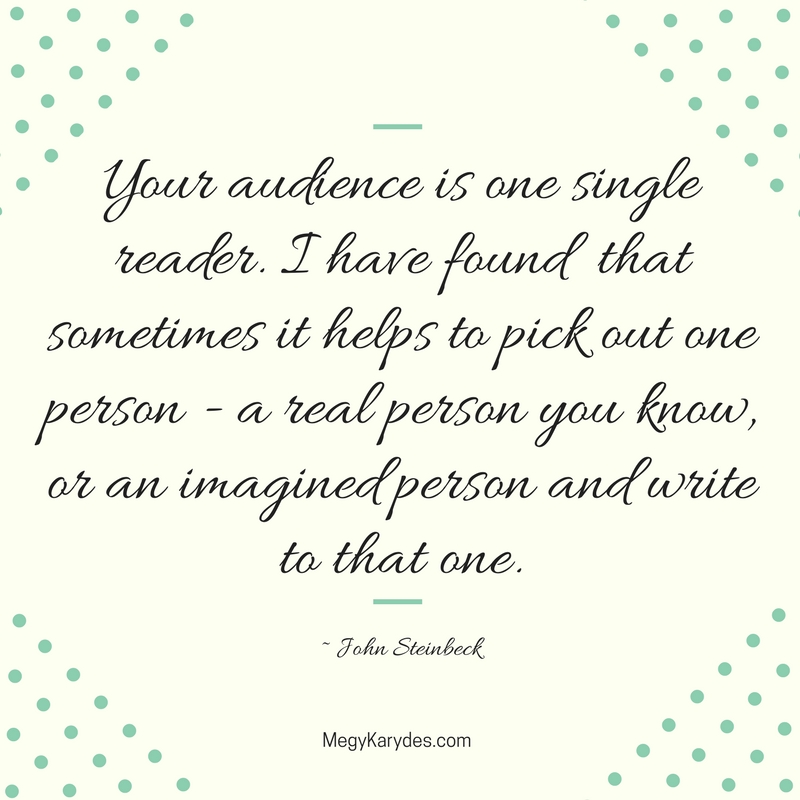
"Your audience is one single reader. I have found that sometimes it helps to pick out one person - a real person you know, or an imagined person and write to that one." ~ John Steinbeck
Then a friend of mine referenced Steinbeck and I came across this interview on how to get started and between Elder’s prompt and Steinbeck’s comment to write for one individual person, it clicked for me.
And then, of course, you are faced with the blank page once you’re ready to start. For this, too, Steinbeck has some advice and it’s similar to Elder’s: just start.
I share this because now that the proposal is complete and I’m in the process of researching agents, several people have asked me about my process. Several things worked for me, including developing a consistent writing practice where I tackled specific parts of my proposal at any given time and blocking out hours at a time on a weekend morning at the library where there were few distractions. I also took to heart both Elder and Steinbeck’s recommendations: start writing and consider your audience of one.
From The Paris Review, here are more of Steinbeck’s recommendation in the form of a letter to Robert Wallsten in February of 1962:
“Now let me give you the benefit of my experience in facing 400 pages of blank stock—the appalling stuff that must be filled. I know that no one really wants the benefit of anyone’s experience which is probably why it is so freely offered. But the following are some of the things I have had to do to keep from going nuts.
1. Abandon the idea that you are ever going to finish. Lose track of the 400 pages and write just one page for each day; it helps. Then when it gets finished, you are always surprised.
2. Write freely and as rapidly as possible and throw the whole thing on paper. Never correct or rewrite until the whole thing is down. Rewrite in process is usually found to be an excuse for not going on. It also interferes with flow and rhythm which can only come from a kind of unconscious association with the material.
3. Forget your generalized audience. In the first place, the nameless, faceless audience will scare you to death and in the second place, unlike the theatre, it doesn’t exist. In writing, your audience is one single reader. I have found that sometimes it helps to pick out one person—a real person you know, or an imagined person and write to that one.
4. If a scene or a section gets the better of you and you still think you want it—bypass it and go on. When you have finished the whole you can come back to it and then you may find that the reason it gave trouble is because it didn’t belong there.
5. Beware of a scene that becomes too dear to you, dearer than the rest. It will usually be found that it is out of drawing.
6. If you are using dialogue—say it aloud as you write it. Only then will it have the sound of speech.”
Steinbeck’s thoughts are meant for a writer but they needn't to be limited to that demographic.
When I’m pitching a story to a reporter on behalf of a client or marketing a product, it helps to think of that one person who is receiving your message. It makes your message that much stronger and authentic.
Right now, I’m thinking of someone very important to me as I continue this process. Who knew Steinbeck would play such a pivotal role in my work and life.
While I can’t raise a glass and enjoy a nice cold cocktail with Steinbeck right now, I hope he’ll accept a virtual cheers, wherever he may be.
Praise For The Paper Planners

Megy's paper planners overs the years.
I’m a visual learner so paper planners have always worked better for me for scheduling and planning purposes. I’ve tried online versions but the hand/eye and tactile experience of writing something down helps me process a project better. I’m not alone. Science shows that those who handwrite their notes rather than type them retain information better.
Over the years, I’ve found several that have worked for various reasons. My Passion Planner was great and it was when I realized I needed the vertical landscape to best schedule out my day. As a marketing and PR consultant who works with several clients at a time, I need a good way to keep track of my billable hours. While I use a tool online to track my hours when I’m on my desktop, not all my work happens behind a computer (in-person meetings, for example). Having a paper calendar allows me to block out that time so I can keep accurate records.
I graduated from my Passion Planner to Planner Pads and, I’ll admit, this layout made a lot of sense to me. The inverted pyramid approach lets you lay out ALL of your projects needing completion at the top of the 2-page spread, then you filter those items into each day you want to complete them in the second section of the page before you finally drill down and plot them by the hour in the bottom section of the page. The layout lets you start with big picture first then progresses to helping you plan it out by hour/day.
GoalDrvn is a powerful planner, packed with possibilities and bells and whistles, despite its digest-sized shape. What makes this different than the other planners I’ve tried is it makes you focus on your goals in a very analytical way, rather than amorphous. Some planners, like the Passion Planner, encourage you to daydream about your goals. To be sure, there is a time and place for that level of introspection. I would take a Passion Planner to a silent retreat, for example, or use it to help drive exercises around big picture dreams like what I want out of my life, what makes me happy, what I’d like to learn or do more of, that sort of thing. GoalDrvn’s front-of-book exercises encourage that kind of thought process but its format was created to support big goals you’ve pretty much figured out you want to achieve.
The leather-bound book encourages users to identify their Master Goal first and then walks the user through various exercises to help you create action goals. Those action goals should include steps to accomplish as well as a deadline.
Here’s where I think the planner is genius: it includes a very practical yet overlooked exercise. Before you tackle the details of each goal, there is a page that asks you to share what skills sets you need to learn to achieve this master goal, whose help you might want to enlist and what obstacles might you need to overcome.
This simple exercise helped me overcome a major stumbling block.
I used GoalDrvn to plot out the work I needed to get done to successfully complete and publish my memoir. From completing various sections of my book proposal to securing an agent and building a platform, I’ve identified my top goals. But then I hit a stumbling block. This project, as much as it means to me, meant I needed to siphon off time from other projects and my family and that’s not easy when you have two little kids who want your attention and are out of school for the summer, you work full-time for clients who expect you to deliver, and a husband who is constantly training for a marathon or triathlon.
When I looked at this page, I realized I needed to enlist some help to overcome an obstacle. I needed permission to carve out much-needed time to complete this proposal and that help had to come from my husband. He and I agreed to take the kids for chunks of time (and even days) while I holed myself up in a Wisconsin cabin for uninterrupted writing time.
Guess what happened? I finished my book proposal. I knew it needed a few more tweaks before I could send off to my beta readers but it got done.
The rest of the planner is great, too. You can use as much or as little of the bells and whistles as you’d like. It has a section on adding more balance in your life by including a habit you want to develop (such as making it a point to meditating daily or drinking enough water). It also includes little cliff notes version of things so you can move over action steps like a Bullet Journal (which helps since the planner is digest-sized).
Another thing I like about this planner is it gives you 30-minute chunks of time, starting at 6:00 a.m. through 11:00 p.m. While I can’t jot down my 15-minute admin stuff easily in 30-minute spaces, I can make note to “admin stuff” in that space and just try to tackle two things.
Since we’re at the mid-year mark, I’ll need to start thinking of which planner to use for 2018 since I have deliverables, events and conferences planned for next year. I’ve been using GoalDrvn for just over a month now and really like it. I’m going to see if I can use it exclusively for the next month and see how it fares against my Planner Pad, since I’ve been using that for more than a year now.
Do you have a favorite paper planner? Which one do you use and what about it do you feel works so well for you?

Megy’s 15/5 Approach To Being More Productive
Time Management Tip: The Power of 15 minutes & 5 Things.

15 minutes and 5 tasks a day = more productive & happier. Photo Credit: PicJumbo.
In an effort to maximize my time, I’ve been testing different time management techniques. The Yesterbox approach is still working for me as a way to tame my email in-box. It’s not yet at zero emails but it’s definitely more manageable. Lately, I’ve been trying something else with great success: the 15-minute or less task and 3-5 hot projects list.
15 Minutes
We all have big projects to tackle, whether they’re a massive work project or a remodeling job at home. We also know that in order to tackle those big projects, we have to break them down into actionable steps.
But in between those big projects, we have what I call admin stuff. Admin stuff is stuff that just needs to get done on no particular day but sooner rather than later. Most of those things won’t even take longer than 15 minutes but because they don’t have a deadline, I fail to plot them on my schedule. So, naturally, they don’t get done and they get moved from one week to the next, which is not only annoying but not efficient or productive (translation: time waster).
Right now, I have approximately 10 of those admin tasks to complete. They range from making my annual doctor’s appointment to creating an invite for my son’s birthday party. Or registering my daughter for her after-school activity and sending an email to a friend asking when we’re getting together. See? Nothing here should take longer than a few minutes.
So I’ve dubbed these admin tasks as my 15-minute of less tasks and highlight them in my paper planner as such. When I happen to have an extra 15-minute pocket of time (like when a client is running late to get on a call or another project gets done early), I tackle one of those tasks in the order in which I deemed them important to complete.
In some cases, I’ve gone as far as scheduling them on my planner. The trick is to find the right planner (more of that next month).
The other way my 15-minute task is helping me get more done is because there is usually a project I’m just dreading to work on or start. I don’t want to commit an hour to it. Or even half an hour. But 15 minutes seems non-commital enough but it keeps moving the project forward. Sometimes I just need to get over that initial hump to get started on a project because once I get past that hump, it all falls into place.
Who knew 15 minutes could be so productive.
3-5 Hot Things
The other trick that seems to be working for me is to make a list of 3-5 things I need to get done that day. That’s it. Even if my “to do” list is 10-20 items long, the reality is they won’t all get done in one day. Worse, it’ll feel overwhelming so chances are only 1-2 things will get done instead of the 3-5 that could’ve gotten done had I only focused my attention to those instead.
So now, only 3-5 things go on any day’s task list. The rest of the action items get doled out throughout the week. If I manage to knock out my day’s list, then I can choose to look ahead and tackle something the following day or enjoy the rest of my day by reading or catching up on other non-work-related stuff.
It’s quite freeing, honestly, to only have a few things to tackle a day and, better yet, my productivity is soaring because I’m not tempted to multi-task, I can focus on the task at hand and get it done faster because nothing else is competing against my time.
Have you found any time management tips that have worked well for you? Comment and let me know - I'm always willing to try new tecniques!
How Yesterbox Saves Me HOURS
As a writer and business consultant, I’m obsessive and protective of my time. Like you, I have 24 hours in one day and want to maximize every minute.
Time is a luxury.
Most people consider social media sites like Facebook and Twitter their biggest time suckers. I use RescueTime to track where I spend my time (and Toggl to track my time) and while I kind of knew this to be true, it’s striking how many HOURS a week I spend on email.
I’m not the only one to be drowning in email and feeling guilty that I’m not responding to people quickly enough. Even worse is feeling like I’m going to miss an important email through all the junk I have to wade through hourly, let alone daily. Tony Hsieh, CEO of Zappos.com, felt the same email stress and came up with a brilliant idea called Yesterbox.
YESTERBOX ~ YES!
You can read the details of how Yesterbox works here but the premise is this:
1) Your “to do” list is yesterday’s inbox. By going through all of yesterday’s emails today, you’re not only responding to everyone who needs a response, but you’re not distracted TODAY with emails coming in, allowing you the freedom to focus at the task at hand.
2) For emails that require a longer response time, you file them into an email folder and schedule a time on your calendar to respond to them.
3) To get through older emails, schedule a time on your calendar and wade through them. Quickly you’ll realize many of them can now be deleted anyway since they’re not timely, relevant, or important.
Bonus tip: Through Tony’s post on Yesterbox, I learned about Pocket. Pocket is an app that saves anything with a web address to “read later”.
I’ve been testing the Yesterbox method this month and it’s been working for me. I’ve still not hit the elusive ZERO in-box but I’m slowly whittling away the emails and cleaning up house. More importantly, I’m feeling more in control of my in-box, which is making me happy. As of this morning, I have 3,104 left to delete, file or respond (obviously this doesn’t include any emails coming in). The biggest challenge for me is resisting the urge to respond to emails as they arrive. I’ve begun informing my clients that I’ll be checking email three times a day (9:00 a.m., noon and 2:00 p.m.) so they can expect a response from me around that time. Or, if it’s urgent, they can text or gchat (which they’ve done and I’m fine with it).
My goal by the end of May is to get to ZERO. Can I do it? I guess we’ll find out come May 31! I’ll have to report in my June e-mail newsletter/blog post.
Podcasts
Last month you may recall that I promised to share some great podcasts I’ve either been listening or have been recommended. My call for recommendations resulting in an impressive (and LONG) list so I’ve been going through them. I’ll share my list next month because I’m only half-way through everyone’s recommendations and I want to share a complete list with you.
Book Process

Megy and Erin enjoying lunch at Cento in Madison, Wisconsin, as we discussed the chapter summaries for my book proposal. It's getting there. Slowly, but surely, my book proposal is coming together thanks in large part to Erin's patience.
As many of you know, I’m working on a book proposal for a memoir on my family’s life as refugees through a program called The Fifth Semester. The process has been going well and I’m so grateful to my mentor/professor Erin Celello who’s been my cheerleader along the process and encouraging me to dig deeper.
My goal was to have a complete book proposal before our program participants meet next week in New York City and while it’s really close, it’s not quite there yet. I’d rather continue to work on it and get it right than rush it to be done. I can’t wait to meet up with my fellow writers to get their feedback on the proposal, too. I’d like to be shopping it out to book agents by summer.
Book Winner!
Finally, every month I’ll be giving away a book to one of my email subscribers. April’s winner of V is for Vegan by Kerstin Rodgers was Kj! Know of someone who’d like to subscribe to this monthly newsletter ~ forward this email or have your friend click here.

#RightWhereIAm ~ Why this matters
April 3, 2017
#RightWhereIAm ~ Why this matters
This Month’s Writing Update
Thank you for being here with me. Know it means a lot that you’re taking the time to read this email.
I’ve not shared this with anyone yet but it’s particularly exciting to announce that on Saturday morning, at 6:30 a.m., I wrapped up my #ShittyFirstDraft of my 43 chapter summaries. I woke up before 4:00 a.m. to get it done so I could send it to my professor at The Fifth Semester and get her feedback before our trip to New York City next month.
It stands at 12,455 and 53 pages in length. For those who are wondering, it took me approximately 25 hours to write and do a first round of edits on those chapters. I have no idea if that’s fast or slow or what. I just know that it felt like a long time to me.
I’ve also been thinking a lot this month about why this book matters so much to me and wondering if going the memoir route is a good idea. I’ve also been thinking a lot about what it means to feel like I belong here (and “here” can be here in my house, Chicago, the United States). And if not here, where?

#RightWhereIAm
I don’t know if Chicago will be my forever home or not. But as I was writing my chapter summaries, I paused and thought to myself, I’m pretty happy #RightWhereIAm for right now. I loved that idea – right where I am. It’s a double entendre and so fitting that I made it my tentative book title. I created the hashtag to remind me if I post anything on social media that it’s ok to feel good about where I am right now. It may not be where I want to be later in life, but it’s ok for right now. We’ll see where the future takes us.
If you’re so inclined, use the hashtag. I’d love to see where you are right now!
Time Management
Time is at a premium for most of us and while this isn’t an article on time management, per se, it is about how to be a better organizer (which, for me, means less wasted time trying to find stuff). Check it out here. I love the idea of having a junk drawer! I’m still working on dialing down the visual diet and possibly imposing a digital diet.
Podcasts
I’ve been listening to podcasts now for several months and really diggin’ them. One recent find, through someone who’d reached out to me on Twitter because she’d seen an article I’d written about writing programs to help women and girls find their voice, is Women Transcend. Although she only has about a dozen segments, I binged-listened to all of them this week and I feel like it’s a nice continuation to my Women’s Studies classes from my college days.
I’ve been mining my friends to learn which podcasts they love so I can add more to my playlist. I’d love to hear your favorites! Please email me to let me know what you tune into regularly.
Know of anyone who'd like to receive these kinds of emails? Please forward this one to them or encourage them to sign up for the e-newsletter here. The next e-newsletter will reveal the winner of the book giveaway so stay tuned. If you're a subscriber of the newsletter, you're automatically entered. Make sure to open the email so you can see if you're the winner!
Until next time,
~Megy
PS - please don't forget to share your favorite podcasts with me! I'm going to be writing a blog post with my favorites and would love to include yours.

Announcing a New Chapter on Spring Equinox
Many people like to make resolutions on New Year's Day. I tend to think of a Word of the Year and focus on making that my goal. This year's word of the year, thirsty, has to do with me starting a new chapter in my life: author.
Many people like to make resolutions on New Year's Day. I tend to think of a Word of the Year and focus on making that my goal. This year's word of the year, thirsty, has to do with me starting a new chapter in my life: author.

My son and I enjoying some quiet time at the Secret Garden in Larnaca, Cyprus, in August 2016.
Some of you may know that my family and I landed in the United States as refugees thanks to my American passport. It's a story I've been wanting to tell for decades but I never really figured out how to tell it. Then, as I sat listening to Ann Garvin speak at the 2016 Chicago Writers Conference about The Fifth Semester, a writing residency program that helps writers shape their book ideas, I had my "aha" moment. The next day I emailed Ann wanting to learn more. I knew I needed to do this program. Then I got cold feet.
I know Ann knew I was nervous so she reached out to check on me. I didn't have a fully-fleshed out book idea, I told her. She said don't worry. We're here to help you figure it out. I don't need to do it alone. That's when I booked it. I needed to write this book. Either as non-fiction or fiction, but I needed to write it.
The first part of the program would take place the first week of January, in Chicago. Thirsty became my word of the year because I wanted to quench my thirst and figure out some stuff that needed to be answered and this book would help me get those answers. I entered that Chicago loft in Logan Square and met my fellow writing comrades and roommates for the next four days where we'd be sequestered and focus solely on our book ideas. It was magical, cathartic and powerful.
Over the next four months, we'll be working one-on-one with our professor/instructor. I'm working with Erin Celello, author of two novels and an Assistant Professor of Writing for the University of Wisconsin system. Erin has been an amazing professor. Knowing how challenging this book will be for me to write, she's been both empathic and encouraging. Her feedback on my book proposal draft has been nothing short of motivating.
Right now I'm in the middle of writing out my chapter summaries and realizing I need to re-work some of my chapters. This is a much harder process than I initially thought since I'm basically outlining the book. Some parts don't make sense and some chapters could be removed. As I'm writing out the summaries, I'm remembering other details I've long since stored away in my memory bank and that's always fun to remember.
The reason I'm starting to work on my blog is because I want to share my process with you and invite you to share feedback with me. For those who know me personally or professionally, what would you like to see in this book? What kinds of books do you read?
Before I wrap up this post, I wanted to give a shout out to my husband, Matthew Krecun, who has been encouraging me to work on this book for more than a decade. He's been there for me for my entire adult life and without his encouragement, I don't think I'd ever have made this leap. And huge gratitude to my writing tribe: Kate Silver, Debbie Carlson, Cindy Kuzma, Kari Lyderson, Dawn Reiss, Kelly James, Claire Zulkey and Hilary Shenfeld. Finally, to Mare Swallow and the team at the Chicago Writers Conference for having Ann present at the conference last September.
Cheers, friends. Thank you for the positive encouragement so far. It's been nothing short of remarkable and I'm excited to share this journey with you.
~Megy

Setting and Meeting Goals: Hitting It Out of the Park
Earlier this year I mentioned that I worked with a business coach to help me fine-tune my goals for 2016. While I've always been very self-motivated, I felt that I needed an outside perspective to help me identify opportunities where I didn't necessarily see them anymore and figure out what I needed to set aside to make room for new opportunities.
Fast forward to almost the end of the year and I'm proud to say this was, by far, my most successful business year. Why? Because I focused.
Each year that I've worked, either for a corporation or running my own business, I've developed a business plan for myself. I cannot sit still. I feel like there is so much to do, see, and experience, that I want to go see, do and experience. I want to learn new things, challenge myself, and meet new people. I want to tinker with problems, brainstorm solutions, and figure out ways to make things better or get the word out about something neat or important. My problem wasn't that I wasn't good at what I was doing, it was that I wanted to do too much in a short amount of time.
Andrea King Collier, my coach and friend, is a great listener and was able to hone in on this issue almost immediately. When I showed her my "goal" list in December, I'm pretty sure she thought I was nuts. We talked through each and every one of those goals and she reminded me that I didn't need to complete everything in one year and to choose my top five.
TOP 5 GOALS
Once we determined my top 5 goals for 2016, and shelve the rest for 2017 or 2018, it feels like my plate was empty. How could I only focus on 5, I thought? I'd get so bored and quickly! But Andrea persisted. By just focusing on those 5, I'd be able to actually complete them and hit it out of the park.
So whenever an opportunity for a new writing assignment came my way, or a new client wanted to work with me on marketing, communications or PR work, I went back to my 5 goals. Did this opportunity fit with any of those goals? If not, I declined the opportunity.
And, that, my friends, is how I ended up making this my best business year ever: by declining opportunities. Or, more accurately, the wrong opportunities.
2017 GOALS
I'm currently working on my goals for 2017 and while they're not quite yet finalized, my big goal for next year is to work on a book. It's been on my Goals List for years and I think I'm at a point in my life that I'm ready to embrace the project and process and see where it takes me. I'm going to be working with someone to help me through this process (because I strongly believe in surrounding myself with the best in the business and learn from them) and we begin in earnest the first week of January. Perfect.
As I look toward the last month of the year and wrapping up some client projects and writing assignments, I can't help but take a moment to think about all of the people who played a part in helping me get where I am today. I plan to reach out to them in December to thank them.
Sometimes this year feels like a blur because it went so fast, but it still felt great.
Did you meet the goals you set for yourself and your work this year? What do you feel you did well and what do you plan to do to improve in 2017?